
Treaty of Waitangi

 
The signing of the Treaty of Waitangi, February 6th, 1840.  Permission of the Alexander Turnbull Library must be obtained before any re-use of this image.

New Zealand's Founding Document

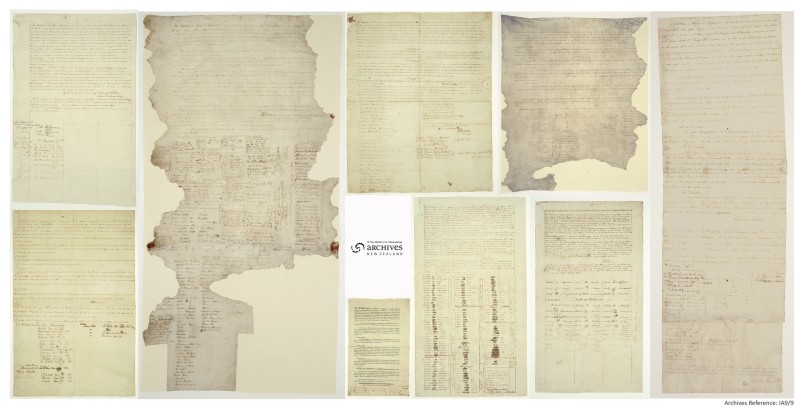
Signed on 6 February 1840, the Treaty of Waitangi is a founding document of government in New Zealand, and established the country as a nation. It is an agreement, in Māori and English, between the British Crown and about 540 Māori rangatira (chiefs).

Before 1840

After Cook's exploration of New Zealand in the 18th century, a growing number of British migrants arrived in the country and there were plans for considerable settlement. In 1832, after increasing lawlessness by traders and settlers, the British Government appointed James Busby as British Resident, effectively a consular officer, to protect British trading interests and counter the growing lawlessness. He arrived in New Zealand the following year but faced an almost impossible task with virtually no budget and no real authority.

In 1835, with the French looking to trade and settle in New Zealand, Busby took a leading role in making the Declaration of the Independence. The document, which has four articles, was signed in 1835 by 34 Māori chiefs, with a further 18 signing in the years that followed. The Declaration states that sovereign power and authority in the land resided with the chiefs collectively and that in return for protecting British subjects in New Zealand, the British Crown was invited to act as their protector.

Treaty of Waitangi

Lawlessness and questionable land sales did not cease with Busby's appointment as British Resident. The British Government eventually decided that annexing the country would protect Māori, better regulate British subjects and secure commercial interests. In 1840, Captain William Hobson was sent to New Zealand with instructions to acquire sovereignty of New Zealand, by way of a treaty with the Māori Chiefs.

A draft treaty was drawn up and translated in a few days. After a day of debate by the Māori Chiefs, the Treaty of Waitangi was signed on February 6, 1840, at Waitangi in the Bay of Islands. Forty-three Northland Chiefs signed the Treaty on that day and about 500 more signed as it, and copies of the original, were taken throughout the country in the following months.

The Treaty has three articles. In the English version, Māori ceded the sovereignty of New Zealand to Britain and gave the Crown an exclusive right to buy lands they wished to sell. In return, they were guaranteed full rights of ownership of their lands, forests, fisheries and other possessions and were given the rights and privileges of British subjects. While the Māori version was deemed to convey the meaning of the English text, there were important differences and the precise nature of the exchange within the Treaty of Waitangi is a matter of debate.

The grounds and building where the Treaty was signed-the Waitangi Historic Reserve-is administered by the Waitangi National Trust Board. The Reserve is a popular tourist attraction and features a large Māori meeting house, the colonial mission house, an historic flagstaff and a waka taua (Māori war canoe).

Next page:Waitangi Day

Government House has been the home and office of New Zealand's Governor-General for more than a century.  Learn more about this iconic building and its role in New Zealand's history, government and constitution.   Find out more.

Features

  • Governor-General's New Year Message
    Sir Jerry Mateparae issues his 1st New Year message - watch the video
  • State Opening of Parliament
    Governor-General announces the Government's plans
  • Speaker-elect confirmation ceremony
    Dr Smith confirmed as Speaker of the House
  • Appointment of the new Government
    The Governor-General appoints the new Government
  • Queen's Diamond Jubilee Emblem
    New emblem to mark the Diamond Jubilee
  • Rugby World Cup
    Message from the Queen of New Zealand on the All Blacks' victory
  • State Swearing-in of Lt Gen The Rt Hon Sir Jerry Mateparae
    A Government House short film
  • Royal NZ Navy 70th Anniversary
    The Governor-General hosted and attended associated events
  • New Zealand Gallantry Awards
    Government House has today issued a special honours list
  • One year on from the 4 September 2010 Canterbury earthquake
    Governor-General issues a message
  • Swearing in ceremony
    Sir Jerry Mateparae to become NZ's 20th Governor-General
  • Sir Paul Reeves
    New Zealand's first Governor-General of Maori descent dies
  • Visit by King George Tupou V of Tonga
    The Governor-General hosted a State Welcome for the King of Tonga
  • Māori King visits Government House
    The King plants a tree to mark the visit
  • Matariki
    The Governor-General's 2011 Matariki Message
  • The Royal Wedding
    Sir Anand and Lady Susan attended the Royal Wedding on 29 April
  • ANZAC Day message
    The Governor-General's message for ANZAC Day commemorations
  • Government House Open Days
    Open Day details can be found here
  • The National Christchurch Memorial Service
    Details and photos are available here.
  • Christchurch Earthquake
    Governor-General offers the support of all New Zealanders
  • Canterbury earthquake
    World leaders send messages of support to New Zealand
  • Waitangi Day 2011
    Sir Anand Satyanand's last Waitangi Day as Governor-General
  • New Year Message
    Governor-General issues his message for 2011
  • Pike River Mine Tragedy
    World leaders send messages of support to New Zealand
  • Governor-General visits Canterbury
    A visit to support and encourage those affected by the earthquake
  • New Year Message
    Governor-General issues his message for 2010
  • Governor-General's 2009 New Year Message
    New Zealanders urged to volunteer