Speech
Charles John Monro Sculpture Unveiling
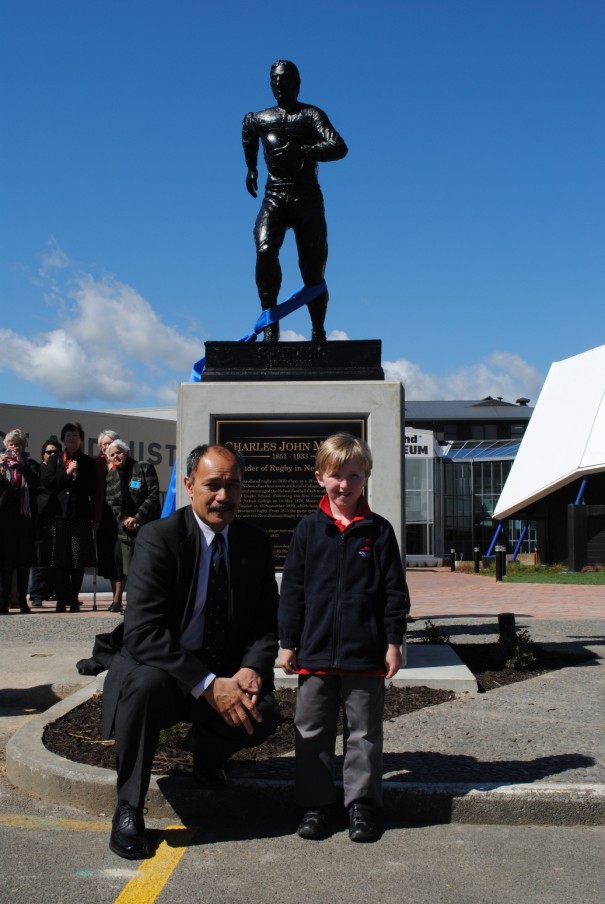
For more images, click here.
Mihi and acknowledgements
Rau rangatira mā me nga manu tioriori, E huihui nei, Tēnei aku mihi māhana ki a koutou, Kia ora tātou katoa. Gentlemen and ladies, warm greetings to those gathered here this morning. In particular, I want to acknowledge His Worship Jono Naylor, Mayor of Palmerston North; Clive Akers, Chair of the New Zealand Rugby Museum; Ian MacRae, Vice-President of the New Zealand Rugby Union; and members of the Monro family. I also want to congratulate Sonny Hawkins for the incredible work you have done to make a dream a reality.
To those responsible, thank you for inviting me to unveil the bronze sculpture depicting the father of New Zealand rugby, Charles John Monro. I consider it a privilege to be part of this occasion, and to meet the descendants of a man who had a radical influence on our country’s social and sporting history.
Rugby World Cup
There is no better time to unveil a statue like this than now as New Zealand hosts the Rugby World Cup. Rugby fervour is all around us, and those New Zealanders that have never had a real interest in the game have come to the commonsense conclusion of “If you can’t beat ‘em, join ‘em!” We are certainly living up to our promise to deliver a “stadium of 4 million”. In two days’ time the stadium moves to Palmerston North and the match between Georgia and Romania, and on 2 October, the city will host the Argentina versus Georgia match.
Vice-regal connections
Today, my comments will be framed around “connections” to do with my being here – Vice-regal connections and military connections.
I will begin by noting the many connections between the Office of Governor-General and the game of rugby. One of the earliest known connections is with the Earl of Ranfurly, Governor from 1897-1904, who donated the Ranfurly Shield. The 107-year-old shield is domestic rugby’s premier trophy and remains a hotly contested prize. Of course, Lord Bledisloe, Governor-General from 1930-1935, gifted the famous Bledisloe Cup, of which the All Blacks are the proud holders.
Lord Freyberg, Governor-General from 1946-1952, also holds an important, although lesser-known place in the history of vice-regal connections to the great game of rugby. Before he was Governor-General, the then Major-General Bernard Freyberg, during his time as General Officer commanding the New Zealand Division, made a prophetic statement in Cairo during dinner with some of his staff. He said:
“This will be a long war but when it is eventually over I want a team of soldiers representing the New Zealand Division to undertake a rugby tour of the United Kingdom. It will help put the game back on the map and at the same time be of value in providing a nucleus of experienced players to assist in post-war rugby in New Zealand.”
Military connections
Dubbed the “Khaki All Blacks”, the Second New Zealand Expeditionary Force rugby team was formed five years later. That team went on to produce an impressive record, with several members going on to become “full” All Blacks, such as Charlie Saxton, Bob Scott and Fred Allen. The team had been preceded by the 1919 New Zealand Army rugby team, which also enjoyed an impressive record playing in Europe.
Those two teams shared the experience of representing their army, and their country with distinction. The mantra that guided the 1945-46 team is still applicable to the game today. That mantra is: position, possession, and pace, to which I add a fourth, which I can confidently say rests in the hearts of all New Zealanders, and that is passion.
Charles John Monro – connection to the military
Speaking of passion, it should be said that Charles John Monro had an intense passion for rugby. He also had an interesting, albeit brief, connection with the military, and another former Governor, Sir George Grey. The story goes that Charles’ father was keen to see his son enter the army and approached Sir George for assistance. However, there is a letter that Charles’ uncle sent his father regarding that ambition and part of it reads:
“As to the idea you have of sending him into the army, if I were asked for my opinion I certainly would say no. Such a school is unquestionably not the best for any lad; being an idle,good for nothing and most unprofitable life and quite unfitting a young man for anything afterwards...He never will learn good manners in the army and will be an ignoramus if he has any time in it.”
I will hasten to add that everyone is entitled to their opinion, and that letter considered Charles entering the British Army! The case has been mostly the opposite for my own involvement in New Zealand’s Army and so that’s why I would tend to disagree with Dr James Monro’s sentiments. Nonetheless, had it not been for his dissuading, Charles may have ended up in the British Army and have never brought the game to New Zealand!
Personal connections
Like most men of my age, I played rugby as a boy, albeit I was better at soldiering than at rugby. At school and later in Australia, I played at halfback, first-five and on the wing—anywhere in the back line really. At one stage in Britain I even played in the forwards! These days I prefer to cheer on my sons from the sidelines, and of course give my full support and enthusiasm to the mighty All Blacks.
Conclusion
And so we have come a long way, since 1870 when Charles John Monro introduced rugby to the sporting youths of Nelson and Wellington. To the Monro family—you can take enormous pride in your family heritage. It has truly shaped our nation in many ways, and continues to inspire unity, comradeship and a commitment to being the best in the world. It has become a part of our national identity, symbolising all that is great about Aotearoa – New Zealand.
Ladies and gentlemen, and especially the Monro family I think we are fortunate in being able to celebrate a remarkable man’s achievement. Using Charles’ own words, I certainly think that his introducing the game of rugby to New Zealand is something “to blow about” .
I wonder what Charles might think if he were alive today, witnessing his “old school game” being played in New Zealand to a global audience, with our national team, the All Blacks, at the top of the rankings. No reira, Kia ora huihui tātou katoa.
It is a great honour to be here today and to, together with Angus Moore, shortly unveil the outstanding bronze sculpture which represents the father of New Zealand rugby – Charles John Monro.