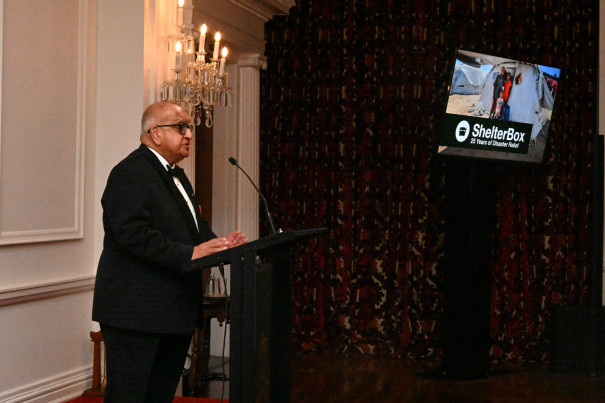
Master of Ceremonies, Distinguished Guests, I greet you in the languages of the realm of New Zealand – in English, Māori, Cook Island Maori, Niuean, Tokelauan and New Zealand Sign Language.
Kia Ora, Kia Orana, Fakalofa Lahi Atu, Taloha Ni and as it is evening (Evening) Sign.
I specifically acknowledge you; Carole Green, District Governor 9940; Shelter Box New Zealand Directors, Brent Eddy, Chair, Directors, Monica Mulholland, Andrew Hamilton, Rebecca Murray, and Jonathan Usher; Dame Suzanne Snively incoming President of the Rotary Club of Wellington following Lynn McKenzie who is also present, you Mike Greenslade CEO of ShelterBox Australia, and you, Rotarians of many ranks from District Governors, downwards, past and present.
Kia ora koutou to all present. Her Excellency the Governor-General, Dame Cindy Kiro is unable to be here tonight, as her scheduled visit to Antarctica was unexpectedly brought forward to this week.
However, Dame Cindy was keen to support this dinner celebrating the 25-year association between ShelterBox International and Rotary, (a little more of which in a moment) and I was very pleased to be invited to be tonight’s stand-in host. My wife, Lady Susan, also a Rotarian of long-standing is unable to be here because she has had a fall and is in Wellington Hospital. She knows of tonight, and offers her best wishes for our endeavours.
Inevitably, I feel something of being a player brought in off the Bench tonight, given that Susan and I spent five eventful years at Government House during my own term, now one and half decades ago. In that time, I was fortunate to encourage a number of opportunities to engage with Rotary, a highpoint of which was an afternoon tea of some hilarity when the 2010 Rotary International President, Ray Edward Klinginsmith, of Kirksville, Missouri visited Wellington. Because of this house being reconstructed, we were only able to receive him in a small house in the grounds, so the Government House fine china came to be applied, in hugely budget circumstances. He was a man of warm wit, with an encyclopaedic knowledge of Rotary and the event went off well, with good humour, the classic government house tea, cakes and sandwiches, and no broken crockery. It was another occasion when my connection with Rotary has been within a continuing rewarding strand.
I am proud of the contribution that Rotary makes to the wellbeing of our communities, by helping New Zealand institutions and organisations to do their invaluable work – from CCS Disability Action, Asthma New Zealand, Cure Kids, and Defensive Driving, to the Dame Malvina Foundation, Outward Bound and Probus – to mention just a few, locally, and Erks, Polio Plus and Give Every Child a Future, within our Pacific region of influence as a country.
I am not the first person to observe that volunteering is the glue that holds our society and economy together – or that our health, education and social service sectors would be in danger of grinding to a halt without the huge number of hours of voluntary work many people provide, including people who are here tonight.
The Māori principle of manaakitanga – upholding the mana or well-being of others – calls on us to observe a reciprocal duty of care, and to help people suffering from misfortune, wherever we can.
As it is said, generosity begins at home, and for many New Zealanders, that includes our close neighbours in the Pacific. In the aftermath of natural disasters, New Zealand is prompt with both official responses and private donations. We in our own Club have helped in providing ERKS (as Emergency Response Kits are properly called) under the leadership of fellow Wellington Rotarian, and senior retired diplomat, Nick Hurley in his role as Chair of Rotary New Zealand World Community Service Limited. Those kits have been made available in partnership with Pacific governments and Rotarians.
I appreciate that it is more challenging to get attention about humanitarian needs in countries that are more remote and largely unknown to New Zealanders.
That is where the approach of Rotary around the world comes into play. We intrinsically recognise the bonds we share with the rest of humanity, wherever they might be on the planet.
Wherever local clubs exist, they can act as effective advocates with officialdom to facilitate ShelterBox relief efforts, and their local knowledge and contacts can inform decision-making.
Sir Edmund Hillary, a dedicated Rotarian from Auckland for much of his life, as well as being no stranger to this House as a Member of the Order of New Zealand, made the case for international humanitarian aid when he said: “If you have plenty – more than enough – and someone else has nothing, then you should do something about it.”
In the aftermath of armed conflict or natural disasters, people are often left with next to nothing. If we imagine ourselves for a moment, transplanted into their place – and in a nation where the civil authorities and central government lack the capability to provide assistance – we would be hugely grateful to see an organisation like Shelter Box swing into action and provide us with shelter from the elements.
Everyone involved with ShelterBox – whether you are a Board member or a volunteer – can take satisfaction from supporting such critical humanitarian work.
Sir Edmund Hillary devoted much of his life to improving infrastructure in Nepalese communities, and he gained as much satisfaction from that work as he did in conquering the world’s highest mountains. I feel certain he would have given his whole-hearted approval to the ShelterBox ethos of prompt, practical support – as a first step towards the rebuilding of shattered lives.
We can observe the demand for Shelter Box support to be on the rise, with so many people around the world affected by geopolitical instability, as well as the increasing frequency of floods, hurricanes, and wildfires.
The Shelter Box mission is more important than ever, and every Rotarian who is helping to fund that work knows that their collective contribution is making a difference. As the revered South African Archbishop and theologian Desmond Tutu, who died in 2021, once said:
“Do your little bit of good where you are: it’s those little bits of good put together that overwhelm the world.”
The ShelterBox story is an example of how big things are possible, no matter the size of the challenge - in the Ukraine now, and in Sri Lanka, Turkey, Bangladesh and Morocco in recent times.
It is heartwarming to think that five friends from a Rotary Club of a town called Helston Lizard, in Cornwall in Western England, with a box of tools from a hardware store, had the audacity to start something that has eventually grown into an organisation with global reach, and we celebrate that start tonight 25 years later. ShelterBox became Rotary International’s official project partner in disaster relief in 2012.
Thank you for your part in the inspirational story, and I trust there will be many more years of fruitful association between ShelterBox and Rotary.
Tonight, as we celebrate 25 years of service and action, I invite you, on behalf of the Governor-General, to enjoy the fellowship of your colleagues and the hospitality of Government House.
Kei nga mihi atu. No reira tena koutou, i te po.